This analysis looks at organizations that signed up since the beginning of 2025 and connected at least two channels to identify which platforms are most often connected together.
What We Found
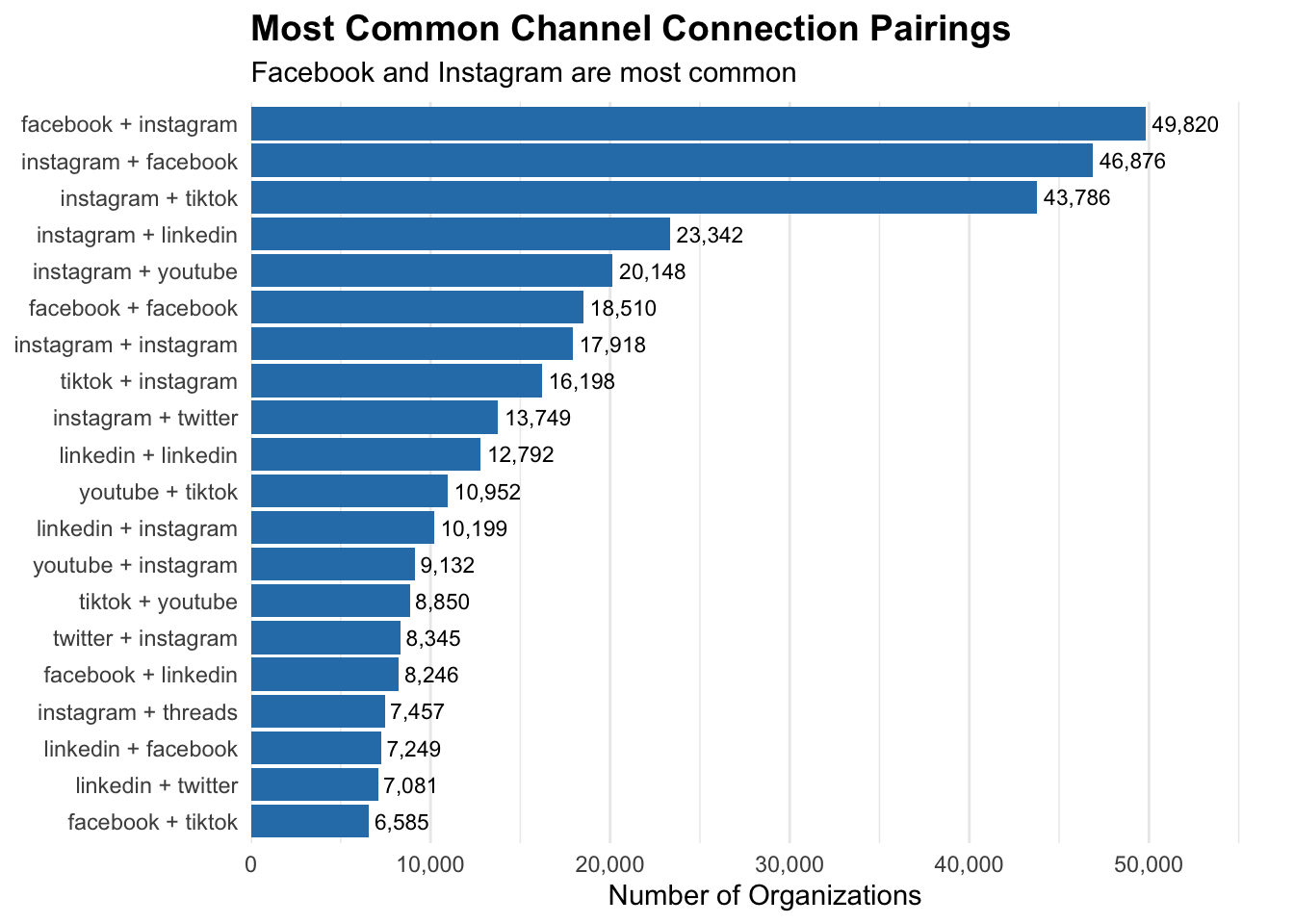
Meta platforms are pretty clearly the most important to a lot of people. The most common pairing is Facebook users adding Instagram, followed closely by Instagram users adding Facebook. The third most common pairing is Instagram users adding TikTok.
There are also some interesting patterns with newer platforms: Bluesky users most commonly add X as their second channel, suggesting that users on decentralized social networks still tend to prefer text-based platforms.
Methodology
We joined the core_accounts and core_channels tables to identify organizations that signed up since January 1, 2025. For each organization, we identified the following:
Their first-ever connected channel
Their second connected channel
The pairing of these two service types
We also looked at the specific channel type (e.g. page, profile, etc.) and excluded deleted channels from the analysis.
Data Collection
The SQL query uses window functions to rank channels by creation time within each organization, then joins the first and second channels to create pairings.
Code
# Query for channel pairings - limited to orgs that signed up since Jan 2025pairings_sql <-"with new_orgs as ( select distinct organization_id from dbt_buffer.core_accounts where created_at >= '2025-01-01'), ranked_channels as ( select c.organization_id , c.service_type , c.created_at , row_number() over ( partition by c.organization_id order by c.created_at asc ) as channel_rank from dbt_buffer.core_channels c inner join new_orgs n on c.organization_id = n.organization_id where c.is_deleted = false), first_channel as ( select organization_id , service_type as first_service from ranked_channels where channel_rank = 1), second_channel as ( select organization_id , service_type as second_service from ranked_channels where channel_rank = 2)select f.first_service , s.second_service , concat(f.first_service, ' + ', s.second_service) as pairing , count(distinct f.organization_id) as org_countfrom first_channel finner join second_channel s on f.organization_id = s.organization_idgroup by 1, 2, 3order by org_count desc"# get data from BigQuerypairings_data <-bq_query(sql = pairings_sql)# save datasaveRDS(pairings_data, 'channel_pairings_data.rds')
All Channel Pairings
The chart below shows the most common channel pairings, including cases where users connect multiple accounts of the same platform.
The Facebook + Instagram and Instagram + Facebook combinations are by far the most common, followed by Instagram + TikTok. Same-service pairings like Facebook + Facebook and Instagram + Instagram appear further down, around positions 6-7.
Second Channel by First Channel
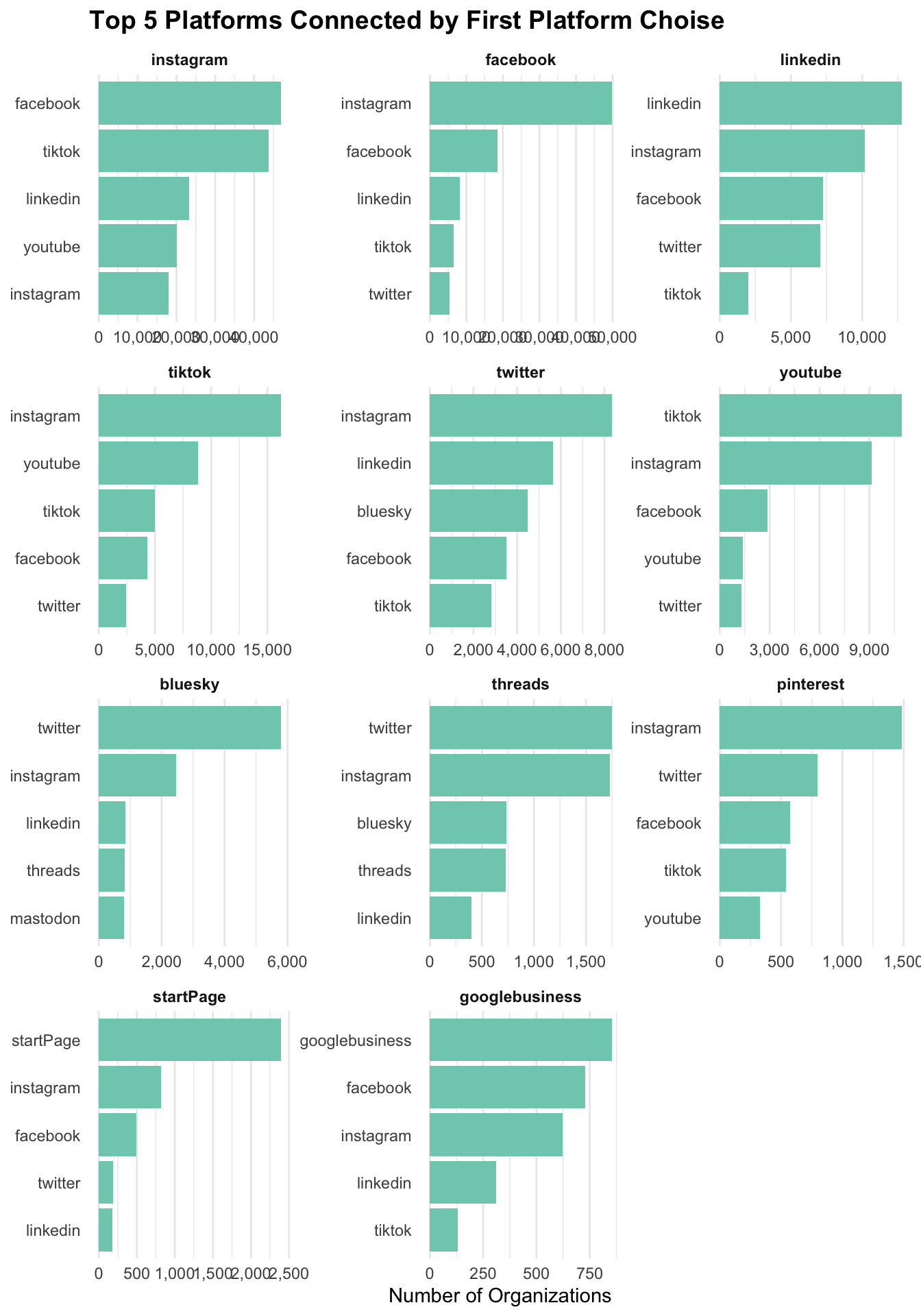
Let’s break this down further by looking at what second channel users connect, grouped by their first channel choice.
A few patterns stand out:
Instagram-first users most frequently add Facebook, then TikTok, LinkedIn, and YouTube. Same-service Instagram pairings rank 5th.
Facebook-first users overwhelmingly add Instagram next, with same-service Facebook pairings a distant second.
LinkedIn-first users are most likely to add another LinkedIn profile, but Instagram and Facebook are close behind.
TikTok-first users most commonly add Instagram, followed by YouTube. Both of these platforms with strong video content overlap.
YouTube-first users most commonly add TikTok, followed by Instagram, showing the strong connection between video platforms.
Bluesky-first users most commonly add X, suggesting a preference for text-based platforms.
Threads-first users are split between X and Instagram as their second channel, reflecting the platform’s position between text-based and visual social media.
Pairings by Service and Channel Type
The analysis above groups all channels by service (e.g. all Instagram accounts together). But Buffer supports different channel types within each servic, for example Instagram business accounts vs. personal profiles, or LinkedIn pages vs. profiles.
To dig deeper, we concatenated each channel’s service and type (e.g. “instagram - business”, “linkedin - page”) and re-ran the pairing analysis.
Code
# Query with channel type includedpairings_type_sql <-"with new_orgs as ( select distinct organization_id from dbt_buffer.core_accounts where created_at >= '2025-01-01'), ranked_channels as ( select c.organization_id , c.service_type , c.channel_type , c.created_at , row_number() over ( partition by c.organization_id order by c.created_at asc ) as channel_rank from dbt_buffer.core_channels c inner join new_orgs n on c.organization_id = n.organization_id where c.is_deleted = false), first_channel as ( select organization_id , service_type as first_service , channel_type as first_type , concat(service_type, ' - ', channel_type) as first_service_type from ranked_channels where channel_rank = 1), second_channel as ( select organization_id , service_type as second_service , channel_type as second_type , concat(service_type, ' - ', channel_type) as second_service_type from ranked_channels where channel_rank = 2)select f.first_service_type , s.second_service_type , concat(f.first_service_type, ' + ', s.second_service_type) as pairing , count(distinct f.organization_id) as org_countfrom first_channel finner join second_channel s on f.organization_id = s.organization_idgroup by 1, 2, 3order by org_count desc"# get data from BigQuerypairings_type_data <-bq_query(sql = pairings_type_sql)# save datasaveRDS(pairings_type_data, 'channel_pairings_type_data.rds')
Most Common Service/Type Pairings
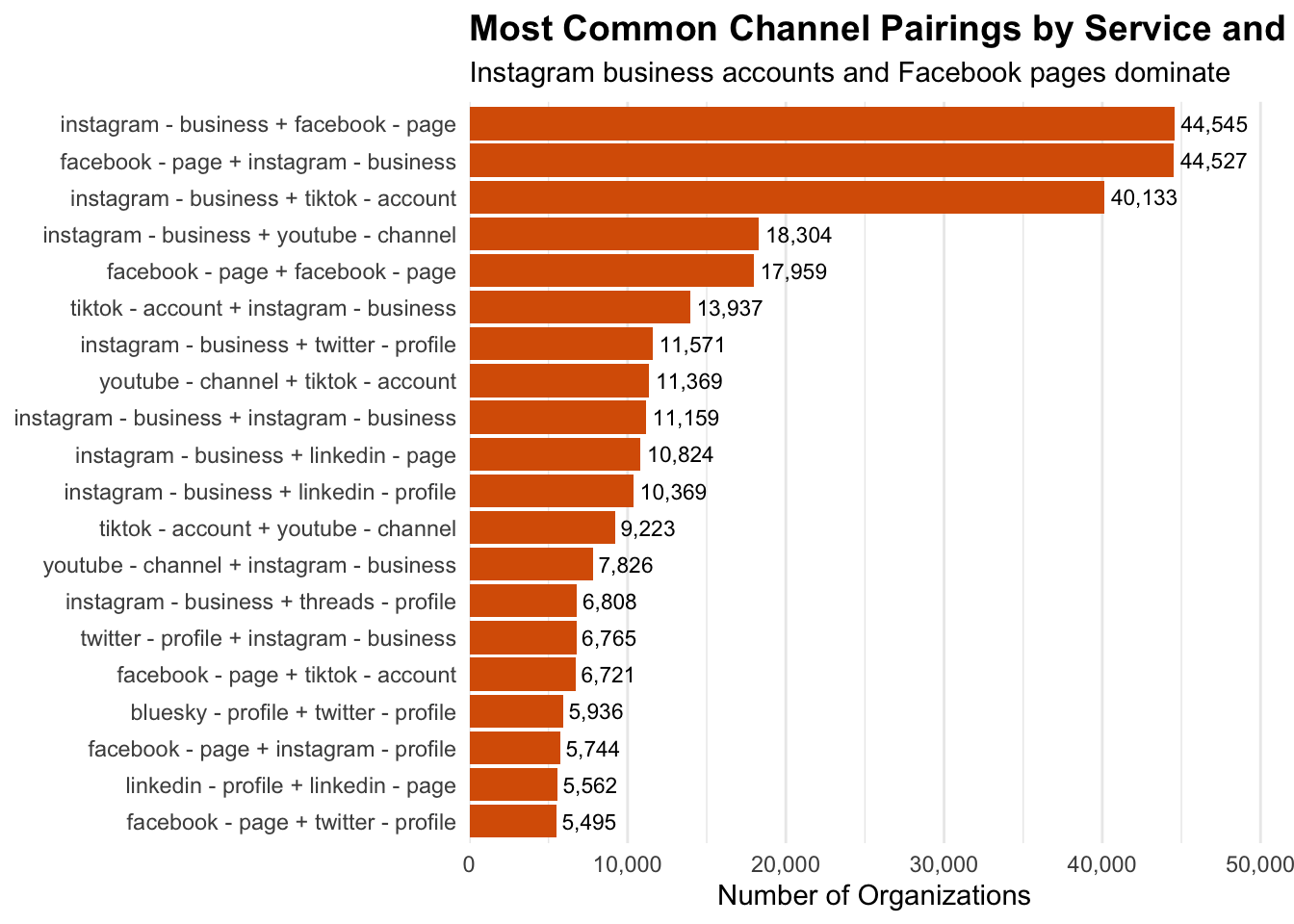
Adding channel type reveals that Instagram Business accounts and Facebook Pages are doing the heavy lifting. The top two pairings, IG Business accounts and Facebook Pages (in either order) account for the vast majority of the Facebook/Instagram connection volume. Instagram personal profiles are much less common and show up way further down the list.
The next most common pairing is Instagram Business + TikTok.
A few other things stand out:
Instagram business dominates Instagram.Of all first-connected Instagram channels, about 86% are business accounts. Personal profiles make up a much smaller share, suggesting that most Buffer users connecting Instagram are managing a brand or creator account.
LinkedIn profiles and pages serve different pairing patterns. LinkedIn profile users most commonly add a LinkedIn page next, and vice versa, suggesting many users manage both a personal brand and a company page. Profile users are also more likely to add X, while page users lean toward Facebook.
Facebook pages add second Facebook pages frequently. The fifth most common pairing overall is facebook - page + facebook - page, indicating that many Facebook page managers are running multiple pages through Buffer.
Top Pairings by First Service/Type
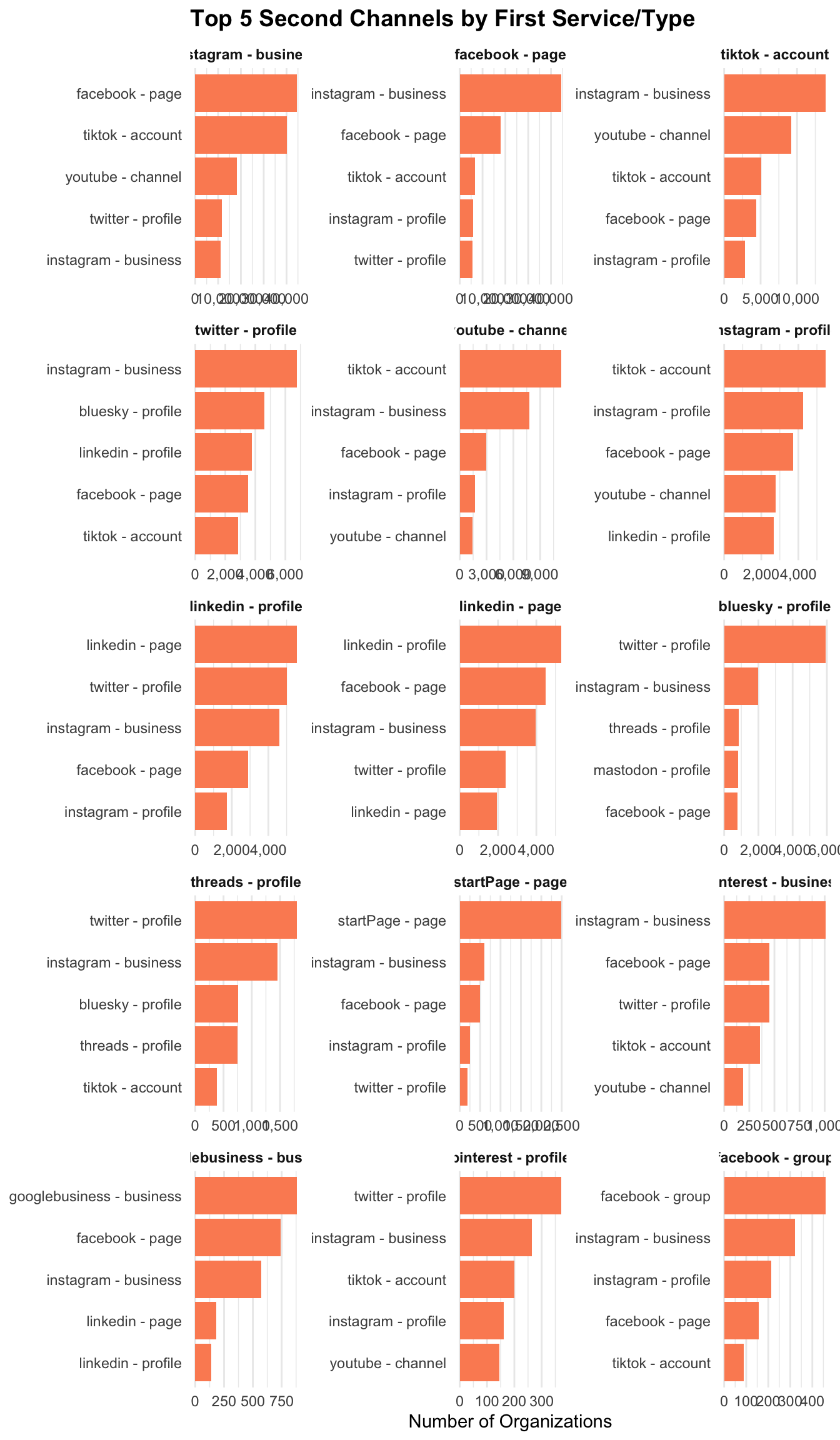
Breaking this down by service and type adds some useful nuance:
Instagram business users most commonly add a Facebook page, followed by TikTok. This is the classic social media manager stack – Meta platforms plus short-form video.
Instagram profile users behave differently from business users. They’re more likely to add TikTok or another Instagram profile, and less likely to add Facebook. This suggests personal-use or creator workflows.
LinkedIn profile users most commonly add a LinkedIn page, then X, then Instagram business. This pattern suggests professionals managing both personal and company presence.
LinkedIn page users follow a similar pattern in reverse – adding a LinkedIn profile first, then branching out to Facebook pages and Instagram business.
Google Business users most commonly add another Google Business profile, then Facebook pages. This makes sense for local businesses managing multiple locations.
Start Page users also tend to add another Start Page, suggesting users creating multiple landing pages before connecting social channels.